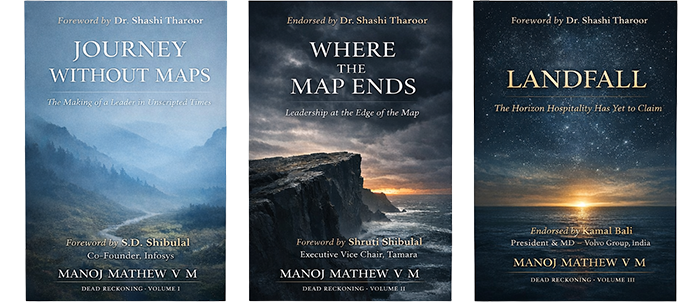
By Manoj Mathew V M, FIIHM | Senior Vice President – Operations, Tamara Leisure Experiences | Author, Dead Reckoning: Leadership by Accumulated Judgment
Curated guest experience in hospitality is not the same as personalisation. Personalisation relies on data. Curation relies on people — and that distinction changes everything about how we think about service, teams, and leadership.
Why Personalisation Alone Is Not Enough
Hospitality has invested heavily in personalisation. Loyalty programmes, pre-arrival surveys, CRM systems, preference databases — all of them designed to make the guest feel known before they arrive. This is useful work. It reduces friction. It signals attention.
But it has a ceiling.
Personalisation responds to what is already known: room preferences, dietary requirements, past behaviour. It is, at its core, a system responding to a record. And records, however detailed, do not capture what a guest carries with them on any given day.
The business traveller who appears in the CRM as a high-value repeat guest may be arriving after a difficult flight, a hard meeting, or a personal loss. The leisure guest booked under “family holiday” may carry urgency or emotional weight that no preference file anticipated. The experience they need in that moment cannot be retrieved from a database. It must be read, in real time, by a person who is paying attention.
“Curated guest experience in hospitality begins where the database ends — in the live, human act of reading what a guest actually needs.”
Curation vs. Customisation: A Critical Distinction
There is a difference between customisation and curation that hospitality leadership rarely examines directly.
Customisation is responsive. It delivers what was requested, what was recorded, what was anticipated. It is highly efficient and largely correct. In a well-run operation, customisation is close to invisible — it simply works.
Curation is interpretive. It asks not what was requested but what is needed. It operates in the gap between the stated preference and the unspoken condition. And it requires a fundamentally different set of capabilities:
- Attention that is not task-driven
- Judgment that is not procedure-driven
- A willingness to act on what is sensed rather than what is confirmed
This distinction — between structure and interpretation, between what is known and what is unfolding — is explored in depth in Where the Map Ends (Vol. II of the Dead Reckoning: Leadership by Accumulated Judgment trilogy). Leadership, like hospitality at its best, operates most meaningfully not at the point of certainty but at the point where certainty runs out.
The Role of Spontaneity in Hospitality Guest Experience
Curation without spontaneity eventually becomes its own kind of system. Attentive by habit. Interpretive by rote.
The most meaningful moments in the hospitality guest experience are rarely designed. They emerge from a team member who noticed something, decided to act on it, and did so without checking whether the action was in the standard operating procedure. A gesture that was not part of training. A response that was not anticipated. A choice made in the moment, without needing permission from a system.
Spontaneity in this context is not randomness. It is informed instinct — the ability to act appropriately, in real time, because years of practice, culture, and care have built the judgment required to do so.
The challenge is that spontaneity cannot be standardised without destroying the very quality that makes it valuable. The moment you build a checklist around it, it ceases to be spontaneous. It becomes procedure wearing the costume of care.
“The most impactful moments in guest experience cannot be scripted. They can only be enabled — by culture, by leadership, and by the freedom to act.”
An Inspired Hospitality Workforce: The Engine Behind Curation
No curated guest experience framework, however well-designed, can deliver itself. Systems support. People execute. But only inspired people go further.
The distinction matters. A well-trained team member follows the procedure correctly. An inspired team member follows the procedure and then notices the thing the procedure didn’t account for — and does something about it.
What creates this inspiration? Not motivation programmes. Not recognition walls. Not yet another values workshop. Inspiration in a hospitality workforce grows from something more structural:
- A leadership culture in which judgment at the front line is genuinely trusted
- Tolerance for the occasional imperfect decision made for the right reasons
- Recognition of intent and care, not just outcomes and metrics
- A workplace in which people feel they are part of something meaningful, not merely operationally proficient
This is not soft thinking. It is the most direct route to the kind of hospitality guest experience that produces loyalty, advocacy, and return visits — outcomes that no loyalty programme alone can manufacture.
Why Over-Designed Guest Experiences Fall Flat
There is a growing tendency in hospitality to design experience down to the smallest touchpoint. Journey mapping. Micro-moment analysis. Experience prototyping. These are legitimate tools. The problem is not the tools. The problem is what happens when the map becomes the territory.
When every interaction is anticipated and every response defined, there is no room for the human signal. The guest may appreciate the experience. They may rate it highly. But they will not feel it in the way that drives the kind of loyalty that no survey fully captures.
Excellence in the curated guest experience is often defined by what did not happen: a discomfort that was anticipated before it arose, a need that was met before it was named, a moment that passed seamlessly because someone was paying attention. Behind each of these is not a system — but a person who chose to act.
Hospitality Leadership and the Space to Act
If spontaneity and inspiration are essential to delivering a genuinely curated guest experience in hospitality, then the primary job of leadership is to create the conditions in which both can exist.
This means allowing deviation from standard procedure without fear of disproportionate consequence. It means trusting the judgment of people who are closer to the guest than the manager is. It means valuing intent as much as outcome, and accepting that not every decision made with good intent will produce a perfect result.
This discomfort — the discomfort of trusting judgment you cannot fully control — is one of the recurring themes in Journey Without Maps (Vol. I of the Dead Reckoning: Leadership by Accumulated Judgment trilogy). Leadership that cannot tolerate imperfection cannot sustain inspiration.
What Genuinely Curated Hospitality Feels Like
Curated guest experience in hospitality is rarely visible in obvious ways. It does not announce itself. It is seldom dramatic. It is felt, not noticed — and that is precisely the point.
Guests who experience it do not typically say “the experience was very well-designed.” They say “I don’t know what it was, but something felt right.” Or: “I felt looked after without feeling managed.” That gap — between what can be articulated and what is actually experienced — is where curation lives.
It is built over time. By culture. By leadership. By teams who have been trusted, inspired, and given the freedom to act on what they see.
“Curated guest experience is not delivered. It is felt. And the difference between the two is the difference between a good hotel and one that people genuinely remember.”
Conclusion: Moving from Personalisation to Curation
Personalisation is the platform. Curation is the practice that makes it meaningful.
As hospitality evolves, the organisations that will build genuine competitive advantage are not those with the most sophisticated data infrastructure — though that matters. They are the ones that build cultures in which inspired, trusted, judgment-capable people use that infrastructure as a starting point, and then go further.
The curated guest experience in hospitality is not a product to be designed. It is a capacity to be built — in people, in culture, and in the leadership decisions that create the conditions for both.