
Dead Reckoning is part of a three-volume series exploring leadership across different stages of development and responsibility.
Each volume stands independently while contributing to a unified body of work.
The formation of judgment in uncertainty.
Leadership when experience alone is no longer sufficient.
A forward-looking examination of organisational continuity, culture, and the future of leadership in hospitality.
Dead Reckoning is positioned as a leadership work for professionals operating in complex, service-driven environments—particularly hospitality, but with relevance to any field where human judgment, real-time decision-making, and organisational culture intersect.
It sits at the intersection of:
The work is reflective but operationally grounded, combining narrative insight with practical relevance.
The book addresses a central question: How do leaders act wisely when the map is incomplete?
Its answer is developed through:
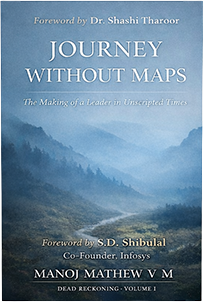
The Making of a Leader in Unscripted Times
Leadership is what remains when the map disappears.
This volume traces the making of a leader.
It is shaped by uncertainty, responsibility, and the discipline of getting things right when it matters most.
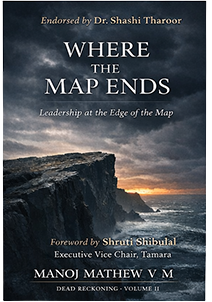
Leadership at the Edge of the Map
When the map ends, leadership begins.
This volume examines decisions made without clarity, where judgment must carry the burden of action.
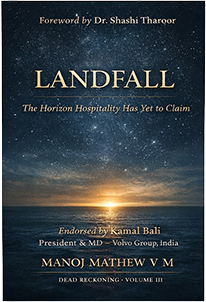
The Horizon Hospitality Has Yet to Claim
Landfall is not a destination. It is a responsibility.
This volume looks at what leadership must become in a fragmented and evolving world.
In the Dead Reckoning trilogy, Manoj Mathew — drawing on his storied experience of four decades of hospitality leadership across three countries — brings to light an oft-overlooked aspect of the hospitality industry: the interior life, exacting and inexorable, of an enterprise built on grace under pressure.
Across Journey Without Maps, Where the Map Ends, and the culminating Landfall, leadership emerges not as a tryst with power, or the right to be imperious, but as a responsibility whose consequences demand forbearance and probity; power here is recast as stewardship — a duty towards both guests and colleagues, hierarchy notwithstanding.
Here is an incisive, ringside chronicle of an industry whose footsoldiers have long gone unsung; an industry where trust is both currency and cost, and where the human touch demands the highest premium. Charming and thought-provoking, Mathew’s writing brings to vivid life the internal chaos and external composure of hospitality, making us reckon with the institutional, ethical, and human costs of building and sustaining a life in this indispensable industry.Dr. Shashi Tharoor, Member of Parliament; author of more than two dozen books